
 中文
 English
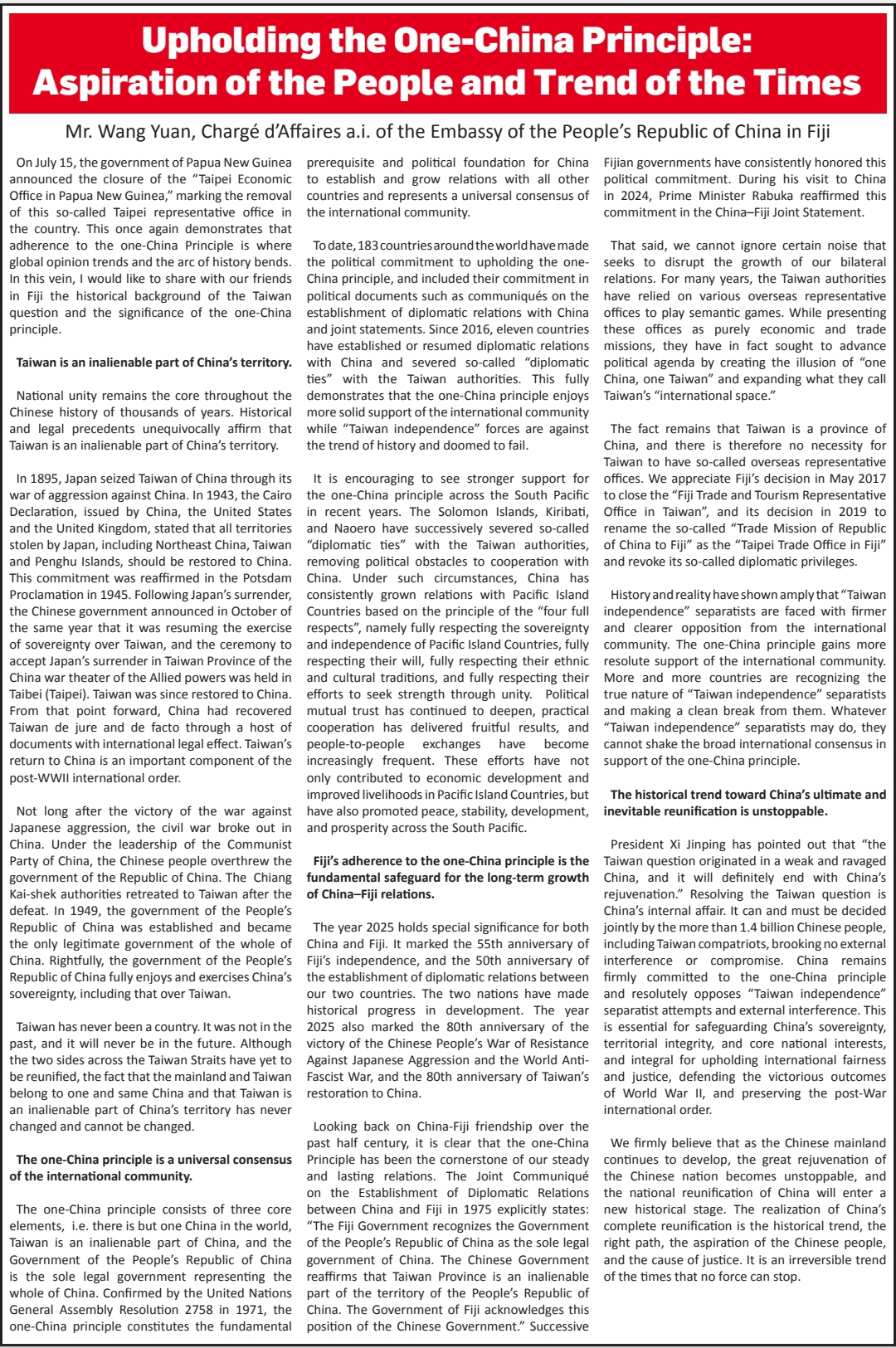
On July 25, Chargé d’Affaires a.i. of the Chinese Embassy in Fiji Wang Yuan published on The Fiji Sun, mainstream Fijian media, a signed article “Upholding the One-China Principle: Aspiration of the People and Trend of the Times”. The article mainly introduced the historical background of the Taiwan question comprehensively, noted that the historical trend toward China’s ultimate and inevitable reunification is unstoppable, and emphasized that Fiji’s adherence to the one-China principle is the fundamental safeguard for the long-term growth of China-Fiji relations. The full text is as follows.
On July 15, the government of Papua New Guinea announced the closure of the “Taipei Economic Office in Papua New Guinea,” marking the removal of this so-called Taipei representative office in the country. This once again demonstrates that adherence to the one-China Principle is where global opinion trends and the arc of history bends. In this vein, I would like to share with our friends in Fiji the historical background of the Taiwan question and the significance of the one-China principle.
Taiwan is an inalienable part of China’s territory.
National unity remains the core throughout the Chinese history of thousands of years. Historical and legal precedents unequivocally affirm that Taiwan is an inalienable part of China’s territory.
In 1895, Japan seized Taiwan of China through its war of aggression against China. In 1943, the Cairo Declaration, issued by China, the United States and the United Kingdom, stated that all territories stolen by Japan, including Northeast China, Taiwan and Penghu Islands, should be restored to China. This commitment was reaffirmed in the Potsdam Proclamation in 1945. Following Japan’s surrender, the Chinese government announced in October of the same year that it was resuming the exercise of sovereignty over Taiwan, and the ceremony to accept Japan’s surrender in Taiwan Province of the China war theater of the Allied powers was held in Taibei (Taipei). Taiwan was since restored to China. From that point forward, China had recovered Taiwan de jure and de facto through a host of documents with international legal effect. Taiwan’s return to China is an important component of the post-WWII international order.
Not long after the victory of the war against Japanese aggression, the civil war broke out in China. Under the leadership of the Communist Party of China, the Chinese people overthrew the government of the Republic of China. The Chiang Kai-shek authorities retreated to Taiwan after the defeat. In 1949, the government of the People’s Republic of China was established and became the only legitimate government of the whole of China. Rightfully, the government of the People’s Republic of China fully enjoys and exercises China’s sovereignty, including that over Taiwan.
Taiwan has never been a country. It was not in the past, and it will never be in the future. Although the two sides across the Taiwan Straits have yet to be reunified, the fact that the mainland and Taiwan belong to one and same China and that Taiwan is an inalienable part of China’s territory has never changed and cannot be changed.
The one-China principle is a universal consensus of the international community.
The one-China principle consists of three core elements, i.e. there is but one China in the world, Taiwan is an inalienable part of China, and the Government of the People’s Republic of China is the sole legal government representing the whole of China. Confirmed by the United Nations General Assembly Resolution 2758 in 1971, the one-China principle constitutes the fundamental prerequisite and political foundation for China to establish and grow relations with all other countries and represents a universal consensus of the international community.
To date, 183 countries around the world have made the political commitment to upholding the one-China principle, and included their commitment in political documents such as communiqués on the establishment of diplomatic relations with China and joint statements. Since 2016, eleven countries have established or resumed diplomatic relations with China and severed so-called “diplomatic ties” with the Taiwan authorities. This fully demonstrates that the one-China principle enjoys more solid support of the international community while “Taiwan independence” forces are against the trend of history and doomed to fail.
It is encouraging to see stronger support for the one-China principle across the South Pacific in recent years. The Solomon Islands, Kiribati, and Naoero have successively severed so-called “diplomatic ties” with the Taiwan authorities, removing political obstacles to cooperation with China. Under such circumstances, China has consistently grown relations with Pacific Island Countries based on the principle of the “four full respects”, namely fully respecting the sovereignty and independence of Pacific Island Countries, fully respecting their will, fully respecting their ethnic and cultural traditions, and fully respecting their efforts to seek strength through unity. Political mutual trust has continued to deepen, practical cooperation has delivered fruitful results, and people-to-people exchanges have become increasingly frequent. These efforts have not only contributed to economic development and improved livelihoods in Pacific Island Countries, but have also promoted peace, stability, development, and prosperity across the South Pacific.
Fiji’s adherence to the one-China principle is the fundamental safeguard for the long-term growth of China–Fiji relations.
The year 2025 holds special significance for both China and Fiji. It marked the 55th anniversary of Fiji’s independence, and the 50th anniversary of the establishment of diplomatic relations between our two countries. The two nations have made historical progress in development. The year 2025 also marked the 80th anniversary of the victory of the Chinese People’s War of Resistance Against Japanese Aggression and the World Anti-Fascist War, and the 80th anniversary of Taiwan’s restoration to China.
Looking back on China-Fiji friendship over the past half century, it is clear that the one-China Principle has been the cornerstone of our steady and lasting relations. The Joint Communiqué on the Establishment of Diplomatic Relations between China and Fiji in 1975 explicitly states: “The Fiji Government recognizes the Government of the People’s Republic of China as the sole legal government of China. The Chinese Government reaffirms that Taiwan Province is an inalienable part of the territory of the People’s Republic of China. The Government of Fiji acknowledges this position of the Chinese Government.” Successive Fijian governments have consistently honored this political commitment. During his visit to China in 2024, Prime Minister Rabuka reaffirmed this commitment in the China–Fiji Joint Statement.
That said, we cannot ignore certain noise that seeks to disrupt the growth of our bilateral relations. For many years, the Taiwan authorities have relied on various overseas representative offices to play semantic games. While presenting these offices as purely economic and trade missions, they have in fact sought to advance political agenda by creating the illusion of “one China, one Taiwan” and expanding what they call Taiwan’s “international space.”
The fact remains that Taiwan is a province of China, and there is therefore no necessity for Taiwan to have so-called overseas representative offices. We appreciate Fiji’s decision in May 2017 to close the “Fiji Trade and Tourism Representative Office in Taiwan”, and its decision in 2019 to rename the so-called “Trade Mission of Republic of China to Fiji” as the “Taipei Trade Office in Fiji” and revoke its so-called diplomatic privileges.
History and reality have shown amply that “Taiwan independence” separatists are faced with firmer and clearer opposition from the international community. The one-China principle gains more resolute support of the international community. More and more countries are recognizing the true nature of “Taiwan independence” separatists and making a clean break from them. Whatever “Taiwan independence” separatists may do, they cannot shake the broad international consensus in support of the one-China principle.
The historical trend toward China’s ultimate and inevitable reunification is unstoppable.
President Xi Jinping has pointed out that “the Taiwan question originated in a weak and ravaged China, and it will definitely end with China’s rejuvenation.” Resolving the Taiwan question is China’s internal affair. It can and must be decided jointly by the more than 1.4 billion Chinese people, including Taiwan compatriots, brooking no external interference or compromise. China remains firmly committed to the one-China principle and resolutely opposes “Taiwan independence” separatist attempts and external interference. This is essential for safeguarding China’s sovereignty, territorial integrity, and core national interests, and integral for upholding international fairness and justice, defending the victorious outcomes of World War II, and preserving the post-War international order.
We firmly believe that as the Chinese mainland continues to develop, the great rejuvenation of the Chinese nation becomes unstoppable, and the national reunification of China will enter a new historical stage. The realization of China’s complete reunification is the historical trend, the right path, the aspiration of the Chinese people, and the cause of justice. It is an irreversible trend of the times that no force can stop.